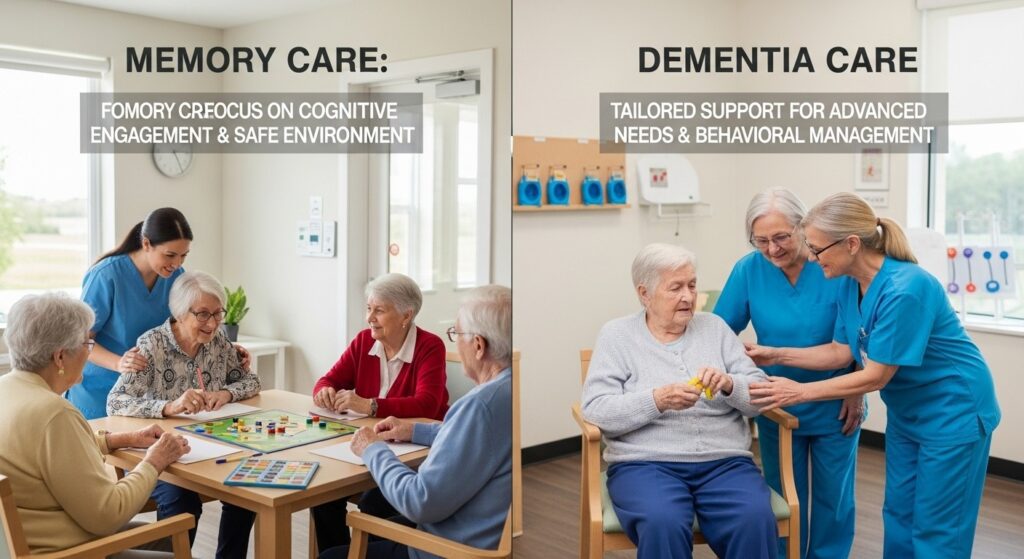
When a loved one needs help because of dementia, the terms memory care and dementia care can make the search confusing. They overlap, but they describe different things.
Dementia care is the broader support provided to someone living with dementia. Memory care commonly refers to a specialized residential program or unit that provides dementia support. Memory care units may operate within assisted living communities or nursing homes. The label alone does not tell you exactly what services, staffing, or medical care a provider offers. Alzheimer’s Association
Understanding that distinction helps you compare the options that matter: care at home, adult day services, assisted living with dementia support, or nursing home care.
What Is Dementia Care?
Dementia care includes the practical, emotional, and healthcare support a person needs while living with Alzheimer’s disease or another form of dementia. It can take place at home, in community programs, or in residential facilities.
Depending on the person’s needs, support may involve personal care, meals, medication assistance, supervision, communication, and coordination with healthcare professionals. The care arrangement should change as the person’s needs change. National Institute on Aging
For families, this means looking beyond memory problems. Consider how the person manages daily tasks, moves around, communicates, and stays safe. Our guide to whether someone with dementia can live alone explores the questions to consider when reviewing home support.
What Is Memory Care?
Memory care commonly describes a residential program designed for people living with dementia. It may be a dedicated community or a specialized unit within a larger facility.
The Alzheimer’s Association describes Alzheimer’s special care units, also called memory care units, as settings where people with dementia receive specialized residential support. However, programs differ. Ask each provider to explain its staffing, training, care practices, and admission requirements rather than relying on the name. Alzheimer’s Association
A provider may offer help with daily activities, supervision, meals, and adapted activities. Confirm what is included, what costs extra, and what care the facility cannot provide.
Memory Care vs. Dementia Care at a Glance
| Comparison | Memory care | Dementia care |
| Meaning | Commonly a specialized residential program or unit | The broader support provided to a person with dementia |
| Location | A dedicated community or part of another residential facility | Home, community programs, assisted living, or nursing homes |
| Main question | Can this particular program meet the person’s needs? | What support does the person need, and where can it be provided? |
| Medical support | Depends on the facility’s capabilities and staffing | Depends on the setting and professionals involved |
| Cost | Depends on location, accommodation, services, and care needs | Depends on the chosen arrangement and amount of support |
| Family involvement | Families can contribute preferences and monitor care | Families may provide care directly or coordinate professional support |
Memory care is therefore one possible setting for dementia care. Choosing support means comparing actual providers and arrangements, rather than treating the two terms as separate alternatives.
Compare the Care Settings Available
Dementia Care at Home
Remaining at home may be workable when appropriate support is available. Family care, professional assistance, home safety changes, and respite services can form part of that arrangement.
Ask whether the plan covers the times when help is needed, including overnight. Also consider whether the caregiver can continue providing support without putting their own health at risk. The National Institute on Aging describes a range of home and community services that can support older adults and their families. www.nia.nih.gov
If the main caregiver needs a break, explore our guide to finding respite care for senior caregivers.
Assisted Living With Dementia Support
Some assisted living communities have specialized Alzheimer’s or memory care units. Ask whether a particular community can manage the person’s current needs and what happens if those needs increase. Do not assume every assisted living facility offers the same dementia support. National Institute on Aging
Nursing Home Care
Consider a nursing home when someone needs ongoing nursing or medical care alongside help with daily activities. Some nursing homes also have specialized dementia units.
Discuss the person’s needs with their healthcare team and compare facilities that can provide the required care. A diagnosis or disease stage alone does not tell you which particular facility will be suitable. National Institute on Aging
How to Decide What Support Is Needed
Before contacting providers, write a brief description of your loved one’s daily needs:
- What help is needed with bathing, dressing, eating, toileting, and mobility?
- When is supervision needed?
- What medication or medical support is required?
- Have there been safety incidents, such as getting lost or unsafe cooking?
- Which routines, relationships, activities, and preferences matter most?
- What help can family members reliably provide?
- What is becoming difficult for the current caregiver?
Bring this information to the healthcare team or a care professional. It provides a more useful starting point than asking only, “Is it time for memory care?”
Planning early gives families time to understand available support and consider future changes. The National Institute on Aging recommends beginning long-term care planning as soon as possible after a dementia diagnosis. National Institute on Aging
Questions to Ask a Memory Care Provider
Use the same questions when comparing communities so you can assess their answers fairly.
Staffing and Training
- How many staff members are available on each shift, including overnight?
- What dementia training do staff receive, and how often is it updated?
- Is a nurse available on site? If not, how is nursing support arranged?
- Who covers absences or staffing shortages?
Safety and Daily Care
- How do you assess a resident’s needs before admission?
- How do you support residents who wander or become distressed?
- What help is available with transfers, toileting, eating, and medications?
- How do you identify and respond to changes in health?
- How are emergencies handled?
Personal Preferences and Activities
- How do residents influence their daily routines?
- How do you support cultural, language, dietary, and spiritual preferences?
- How do you adapt activities to each person’s abilities and interests?
- What happens when a resident does not want to join an activity?
Activities should offer opportunities for enjoyment, connection, and participation. Avoid treating a general activity calendar as evidence that a program slows dementia progression.
Changing Needs and Family Communication
- What needs would require a resident to move elsewhere?
- How often is the care plan reviewed?
- How are families informed about changes or incidents?
- How can residents and families raise concerns?
Request written information and visit the facilities you are considering. For nursing homes in the United States, Medicare’s Care Compare can provide additional information to review alongside your visits. Drupal
Compare Costs Using Itemized Quotes
There is no single price for “dementia care.” Home care, day programs, residential memory care, and nursing homes use different pricing arrangements.
Ask providers for a written breakdown covering:
- Accommodation or base charges.
- Personal care and supervision.
- Medication assistance.
- Additional charges for increased care needs.
- Transportation and other optional services.
- Deposits, notice requirements, and refund terms.
Compare quotes based on the same care needs. A lower advertised price may exclude services your loved one requires.
In the United States, Medicare generally does not cover long-term custodial care. Other payment options depend on eligibility, insurance policies, and local programs, so verify coverage before committing to a provider. www.medicare.gov
An Example of Comparing Needs
Consider a hypothetical family whose mother enjoys living at home but now needs supervision while cooking and help remembering medication. The family could explore whether dependable home support can cover those needs.
If the arrangement later becomes difficult to maintain, they could compare residential programs. If she also develops needs requiring ongoing nursing care, they would need to ask which facilities can provide that support.
The useful question at each step is: Can this arrangement meet her needs consistently while supporting her preferences and the caregiver’s well-being?
If a move becomes part of the discussion, our guide to talking about moving to a retirement home offers ways to involve your loved one respectfully.

Find Encouragement in the Caregiving Journey
One Caregiver’s Journey
By Eleanor Gaccetta
Genre: Memoir / Family Caregiving
Caring for a loved one can bring moments of joy, exhaustion, and uncertainty. In One Caregiver’s Journey, Eleanor Gaccetta shares heartfelt memories, humor, and practical insights from nine and a half years of caring for her mother. Discover a personal story that reminds caregivers they are not alone.
Find Your Copy on AmazonFrequently Asked Questions
Is memory care the same as dementia care?
Memory care often refers to a specialized residential program. Dementia care is the broader support someone receives at home, in the community, and in residential settings. National Institute on Aging
Is memory care only for people with Alzheimer’s disease?
Specialized programs may support people with different forms of dementia. Ask whether the provider has experience and capabilities appropriate for the person’s particular condition and needs. alz.org
Does memory care include round-the-clock nursing?
Do not assume it does. Ask about staffing on every shift, nursing availability, and the medical services the facility can provide. Residential supervision and nursing care are different services.
Can a person with dementia continue living at home?
Home care may remain an option when the person’s needs can be met reliably. Review supervision, safety, available services, and caregiver capacity as circumstances change. www.nia.nih.gov
How do I know when more support is needed?
Document changes in daily functioning, safety, health, and caregiver capacity, then discuss them with the healthcare team. Those observations can guide an assessment of appropriate services and settings.
Choose Support Around the Person
Understanding memory care versus dementia care helps you ask better questions, but the provider’s label is only a starting point. Compare the actual care, staffing, costs, and limits of each option. Include your loved one’s preferences and revisit the plan when needs change.
Eleanor Gaccetta shares the personal realities of family caregiving in One Caregiver’s Journey. For more practical support, explore the site’s guides to caregiver burnout recovery and care routines.